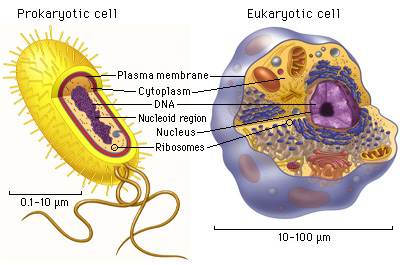
 A comparison between the two types of cells is above. Eukaryotic cells are found in animals and plants, though the organelles can differ and contain a nucleus. Prokaryotic cells
~~~~~~~~~~~~~~~~~~~~~~~~~~~~~~~~~~~~~~ 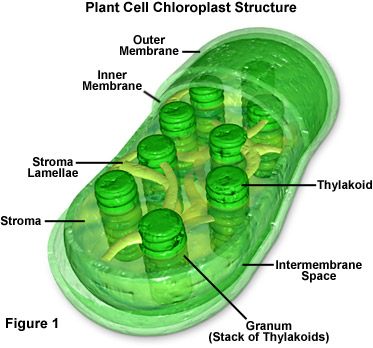 A chloroplast is located in plant cells, helping it convert sun energy into food. It contains thylakoids, which are stackable chloroplast structures and contain photosynthetic pigments. When stacked together thylakoid form granum. And the fluid within the chloroplast is called stroma. _____________________________________ 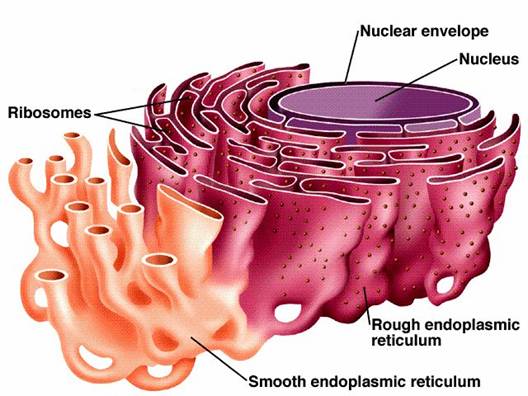 The rough and smooth endoplasmic reticulum are a set of two different connected structures. Both are located on the a surrounding side of the nucleus. Their tubes connect with each other and lead into the nucleus. |
The basic unit of all forms of life is the cell. It's a collection of living matter enclosed by a barrier that separates it froms it's surroundings.
Cells are classified as being either Eukaryotic or Prokaryotic. Eukaryotic vs. Prokaryotic Has a nucleus No nucleus No cell wall Has a cell wall Has a cytoskeleton No cytoskeleton Has a mitochondria No mitochondria Has a Golgi apparatus No Golgi apparatus Has an endoplasmic reticulum No endoplasmic reticulum Both have a cell membrane Both have ribosomes Both have cytoplasm Both reproduce Both grow and respond to their environment The Parts of a Cell Cells consist of many different parts called organelles. An organelle is a special structure in a eukaryotic cell that performs certain functions.
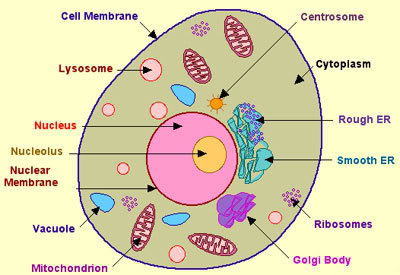 The above picture is of a Eukaryotic cell, within an animal. It consists of many organelles, containing some that others do not, and missing some that others have. Organelles it does not contain are the cell wall, chloroplasts, etc. ~~~~~~~~~~~~~~~~~~~~~~~~~~~~~~~~~~~~~~~~~~~~~~~~~~~~~~~~~~~~~~~~~~~~~~~~ 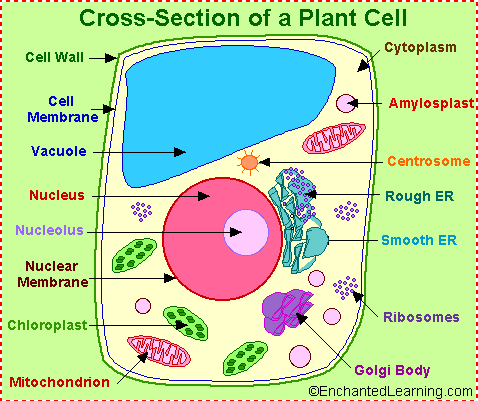 The above picture is of a Eukaryotic cell within a plant. Though the positioning of the organelles can differ throughout plant cells, this is a general example. Several organells that are found in plant cells, but not animal cells are the chloroplast, cell wall, centrosome, etc. |
